
Custom Patch Backing Guide: Iron-On, Velcro & Sew-On
There isn’t one “best” type of backing for all patches. What works well on a jacket might not last on a bag, and what’s good for a single-use badge isn’t suitable for a uniform that’s worn every day. The key is to choose the right backing based on how and where the patch will be used, rather than just picking whatever seems easiest.
When creating a patch, it doesn’t matter how great it looks if it falls off after one wash. The main reason for this is the backing, which is often overlooked.
Many people spend a lot of time choosing colors, fonts, and borders, but they treat the backing as a last-stage decision when they place their order. This mistake is often realized the hard way when the patch starts to peel off a jacket or curl up after a few washes. Even if the design is perfect, it doesn’t matter if the patch doesn’t stay on.
Backing Decides Whether A Patch Survives The Wash Or Not
Four Options But One Quick Overview
Before we get into details, it’s useful to see all the options together. Most custom patches come with one of four types of backings:
- Iron-on, which sticks with heat
- Velcro, for patches that can be removed
- Sew-on, which is stitched to the fabric
- Adhesive, which sticks with a peel-and-stick method
Each type has different advantages in terms of ease of use, how long it lasts, and how strong it is.
Heat, Pressure And A Little Bit Of Time
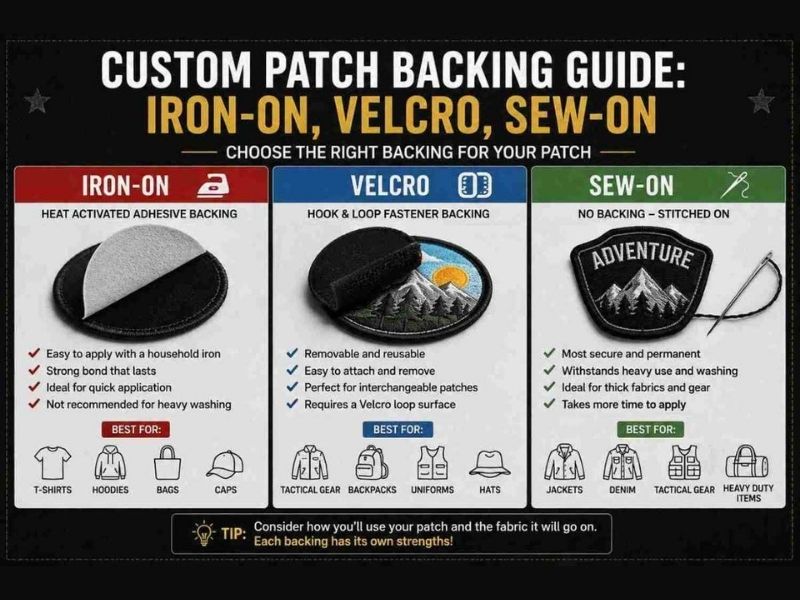
Iron-on patch backing is liked because they are easy to use. All that is needed is a household iron, and there is no sewing involved. To use a patch, the iron should be set to the right temperature and pressed on the patch for 20 to 30 seconds. This helps the glue stick to the fabric.
However, care should be taken not to use iron-on patches on delicate fabrics like nylon or leather, as they can be damaged by heat. Generally, the patches stay on well in the wash, but for heavy items like work jackets or bags, it is suggested that sewing around the edges is done for extra strength. Overall, iron-on patches are a quick and easy choice, but they are not as strong as sewing.
Made To Come On And Off
Velcro backing is used for one main reason: flexibility. It is common in military uniforms, tactical gear, and backpacks because it allows patches to be easily changed for different occasions, ranks, or team assignments.
The design is meant to be temporary, which is exactly what makes it useful. You can peel off a Velcro patch in seconds and put it back on just as quickly, without any tools or glue. The downside is that it feels a bit bulkier than a flat patch that is sewn or ironed on, and you have to sew the Velcro strip onto the clothing first for it to work.
Slower To Apply, Built To Last
Sew on patches take more effort to attach, but they last much longer than other options. Since these patches are stitched into the fabric, no glue can weaken or peel off after washing.
Because of this, sew-on patches are commonly used for items that get a lot of wear and frequent washing, like school uniforms, work jackets, and scouting badges. While sewing them on takes more time and requires either a needle and thread or a sewing machine, it’s usually worth it for items meant to last for many years instead of just a few months.
Peel, Stick And Done
Adhesive patches don’t need heat or stitching. They have a peel-off backing that reveals a sticky side that you can stick directly onto fabric, plastic, or some metal and glass surfaces.
These patches are the quickest option, making them great for short-term uses of custom patches like branding at events, on product packaging, or in temporary displays that only need to last a few hours or days. However, they aren’t made for regular washing or heavy use. Moisture and rubbing can quickly weaken the sticky part, so they work best when you don’t need a long-lasting hold.
Matching The Backing To The Job
When choosing how to attach a patch, think about two main things: how often the item will be washed and how long you want the patch to last. Here’s a quick guide:
- If you need it to last a long time and wash it regularly, sew it on. It’s the strongest option.
- If you want to attach it quickly and need it to last a little while, use an iron-on patch, and you can sew it for extra strength.
- If you need to change the patch often, Velcro is a great choice.
- For short-term use or one-time applications, adhesive works well and doesn’t need any tools.
Remember, there’s no one best patch attachment options. It’s more important to choose the right backing based on how you’ll use the patch.
FAQs
Can iron-on patches be sewn too, for extra durability?
Yes. Adding a few stitches around the edges after ironing a patch on significantly extends how long it stays attached, especially on items washed often.
Are adhesive patches reusable?
Generally, not. Once the adhesive backing loses its stick, usually after one or two uses, it won’t bond as effectively a second time.
Which backing works best for uniforms?
Sew-on tends to be the standard for uniforms, since it holds up best against frequent washing and daily wear over long periods.
Pick The Backing Before Choosing The Design
It’s easy to get caught up in picking colors, logos and fancy stitching, but the type of backing on a garment is what really matters for its durability.
To decide, just ask yourself two simple questions:
How often will I wash this? And how long do I need it to last? Once you answer those, you’ll know what kind of backing is best without needing to think too hard about it.

Hi, I’m Emma Carter. I write about custom iron on patches, creative designs, and branding ideas. I enjoy sharing practical tips and simple guides to help businesses teams and individuals choose the right patches for their projects.