
How to Design Custom Patches That Stand Out for Your Brand
Have you ever observed how a small custom patch can turn your jacket, uniform, or hat into something immediately noticeable? This is the magic of brand design. A patch is not just about putting a logo on fabric. It is the representation of your brand to your desired audience.
What then makes a patch unique and distinctive? All this comes down to details regarding the design of the patch itself, such as the art, the colors, its size, the material used, and even the backing that makes a patch unique. Let’s discuss.
What Makes a Brand Patch Stand Out?
An interesting brand patch must be easy to recognize but different enough to be unforgettable. The importance of contrast, quality design, legibility of letters, and inclusion of brand elements is greater than the attempt to include everything from your logo in one patch.
In the beginning, there is a need for you to select the elements on which you want to concentrate. It can be your logo mark, mascot, initials, or symbols, etc. In case your logo includes some details, it would be better to leave only those that will attract attention.
Keep the Artwork Simple
Patches have limited physical space, and materials such as embroidery have practical limits. Tiny lines, small lettering, and excessive detail can merge during production. Before finalizing the artwork, reduce it to the actual size you intend to manufacture. If an element becomes difficult to understand at that size, simplify or remove it.
Design with Production in Mind
Your patch design needs to be affected by the kind of patch you are creating right from the onset. Embroidery can work perfectly with designs that have bold shapes and letters, while woven patches can capture fine details. You may need significant changes if it is not suitable for the selected material to design your own patch that should look excellent digitally.
What Ideas for Brand Patches Can Work Well?
Your brand patch does not have to be a smaller version of your company logo. A single recognizable element can often create a more interesting and versatile design.
Some practical brand patch ideas include:
- A simplified version of your logo
- A recognizable mascot or character
- Company initials or a monogram
- A product, tool, or symbol associated with your business
- A city, state, or location-inspired design
- A short brand slogan
- A limited-edition patch for an event, anniversary, or product launch
It is possible to make several patches relating to each other instead of just one design. A set of patches can be made using similar colors, typography, shapes, or illustration styles.
How to Choose Colors, Font, and Shape for Your Patch?
Color, font, and shape must all complement one another to make a recognizable brand. Begin by using your established brand color palette instead of trying to create colors that aren’t part of the logo. It is unnecessary to incorporate all colors from the brand palette in the design since sometimes only two or three colors are enough.
Select Contrasting Colors
Contrast is a key factor in the creation of patches because the patches will mostly be seen from afar. While the background needs to contrast with the artwork, the lettering must remain readable and distinct from all other design elements.
Typography Must Be Readable
If the company name, initials, or slogan is included in the patch, select a readable font. Although decorative fonts can give a certain look and feel, sometimes they become hard to reproduce.
Shape Must Complement the Artwork
A typical shape, such as a circle, rectangle, or shield, will suit any logo. Custom shapes will make a patch unique. The shape might complement the artwork, in case the patch is based on the company mascot or a certain product.
The key is visual hierarchy. Someone looking at the patch should immediately understand what matters most without having to examine every detail.
Which Patch Type Is Best for Your Brand?
The choice of the best patch type is based on your artwork, intended application, appearance, and anticipated use. Picking the correct one early will save you from redoing your artwork later.
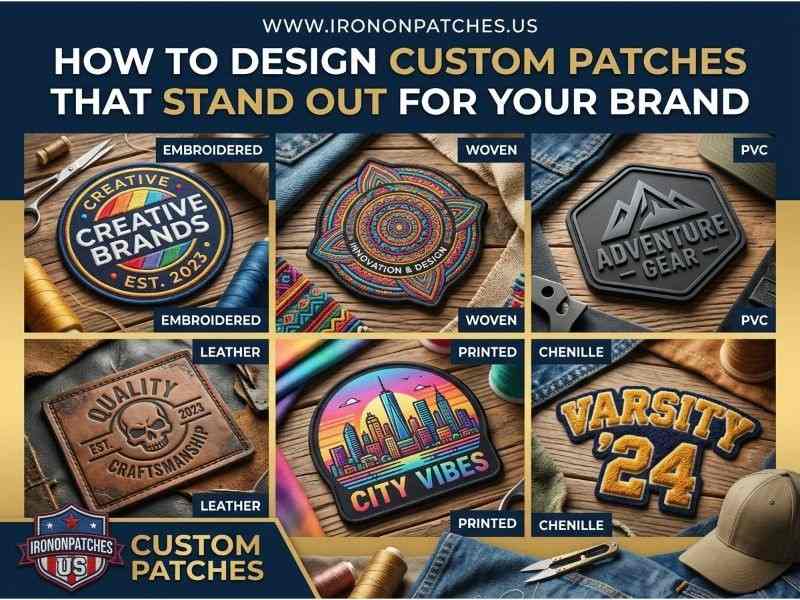
| Patch Type | Best For | Main Advantage |
| Embroidered | Uniforms, jackets, caps, bold logos | Classic textured appearance |
| Woven | Detailed logos and smaller lettering | Smooth surface and fine detail |
| PVC | Outdoor gear and workwear | Durable with clean edges |
| Chenille | Varsity and fashion designs | Thick, raised texture |
| Leather | Premium apparel and bags | Refined, distinctive appearance |
For conventional branding, embroidered patches make an excellent selection as they feature the elevated texture of the threads. Woven patches have more of a flat appearance, which may allow more detail.
PVC patches offer a more modern look and can be useful where durability matters, while chenille and leather provide more specialized visual styles. Rather than trying to establish which one is the better patch of the two, you need to find the right patch for your work of art.
How to Choose the Right Iron On Patch Manufacturer?
Selection of the right iron on patch manufacturer is as crucial as coming up with a good design. It is expected that a manufacturer would transform your digital artwork into a patch that is sharp, long-lasting, and aligned with your brand image. Before placing your order, you need to look beyond the cost and examine their production quality.
These are the things to consider when making your selection:
- Artwork assistance: Make sure that the manufacturer gives clear artwork instructions and suggests designs that cannot be reproduced easily.
- Patch quality: Examine their previous patches’ material, stitching, edges, etc.
- Backing options: Make sure the available iron-on backing is suitable for the garments or products where you plan to use the patches.
- Proofing process: Confirm that you will receive a digital or production proof before the full order is manufactured.
- Customization options: Check whether the manufacturer can produce your preferred size, shape, colors, border, and patch style.
- Order requirements: Review minimum quantities, turnaround times, and other production requirements before confirming the order.
A reliable manufacturer should make the production process clear rather than leaving you to figure out technical details after submitting the artwork. Reviewing these factors early can help you avoid receiving patches that look different from what you expected.
Readers Usually Ask
What is an appropriate size for a custom brand patch?
This will depend on the place, clothing, design, and specifics of the artwork. It needs to be big enough so that all elements will be identifiable but won’t overwhelm the piece.
Is there anything wrong with using my own logo?
No. The logo you already have is usually a good place to start, although some simplification might be necessary. Small fonts, fine lines, and detailed elements do not always translate into a patch.
Is the embroidered patch superior to the woven one?
It all depends on the specific situation because the embroidered patch will work for graphic representation and texture, while the woven one is ideal for fine fonts.
Can you use iron-on patches for business branding?
Certainly, iron-on patches can be used effectively for adding your business logo to various apparel items and accessories.
What file should you send to a patch manufacturer?
Follow the manufacturer’s artwork requirements. High-quality vector artwork is often useful because it can be scaled and prepared accurately, but accepted file formats vary between manufacturers.
To Conclude!
Creating an effective custom brand patch goes beyond merely attaching a logo to fabric. Effective patches include elements such as recognized branding, simple artwork, legible details, appropriate colors, and an appropriate manufacturing process.
The best way to begin is by starting with one effective visual element, designing for the physical space of the patch, using the appropriate material and backer based on the patch’s intended use, and reviewing the proof before manufacturing. When all these elements are taken into consideration, the custom patch will prove useful as a brand component.

Hi, I’m Emma Carter. I write about custom iron on patches, creative designs, and branding ideas. I enjoy sharing practical tips and simple guides to help businesses teams and individuals choose the right patches for their projects.