
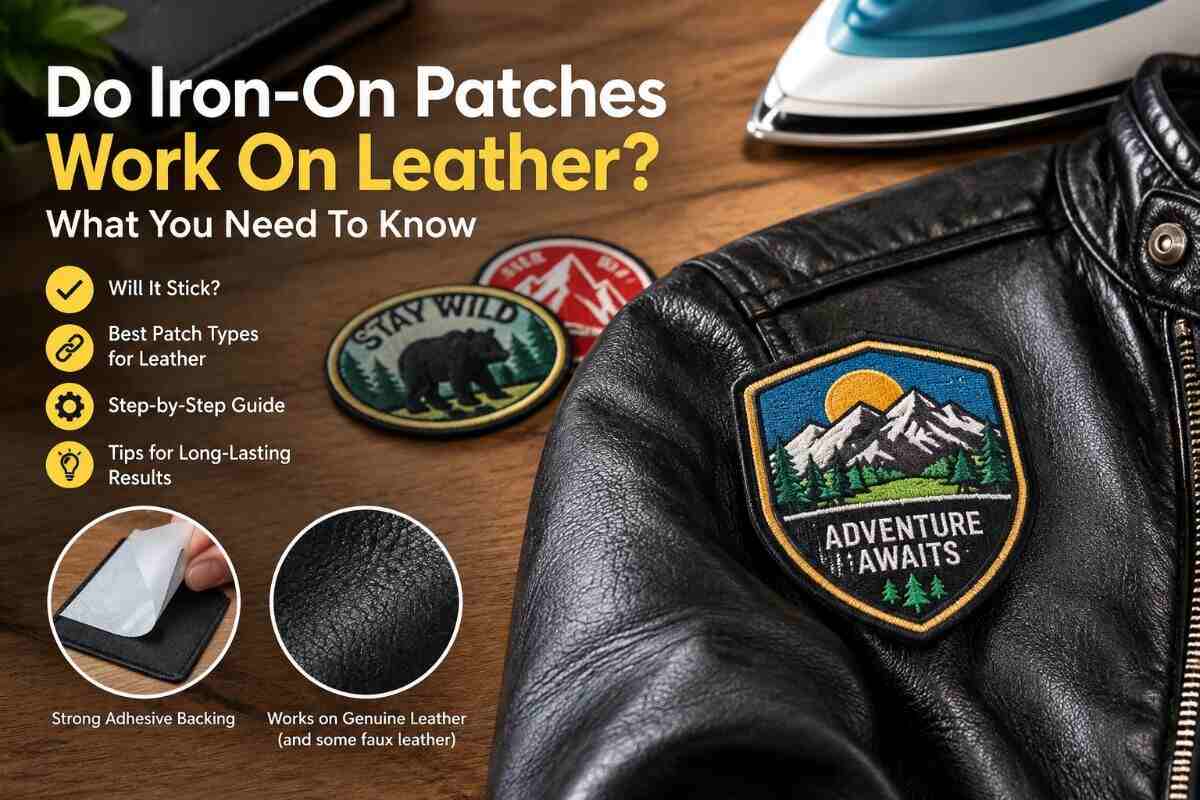
Do Iron On Patches Work On Leather? What You Need To Know
Do you customize leather goods and worry about damage that can be caused by iron-on patches? It is a risky approach to apply patches to your jacket and use trial and error. This can lead to unhappy customers and decreased revenue. You should apply iron-on patches to your jackets safely for this reason.
Leather jackets with stunning patches may look cool and give you a unique look. When you want luxury in your life, you can choose leather. Iron-on leather patches are famous for jackets, hats and bags. This blog will guide you through the complexities of iron-on patches on leather and methods to apply them.
Different Types Of Leather
There are different types of leather that react differently to heat and different types of custom patches. The following are some of them that you can encounter.
| Leather Types | Meaning | Durability | Cost Level |
| Full Grain Leather | Natural texture and very strong | Very high | Premium |
| Top Grain Leather | Sanded for a smooth look | Medium | Mid-range |
| Genuine Leather | Made from leftover scraps | Low | Budget |
| Bonded Leather | Made from leather scraps and binder | Low | Low |
| Vegan Leather | Synthetic alternative | Varies | Low-mid |
| Suede | Soft with a napped finish | Medium | Mid-range |
| Nubuck | Sanded top layer with velvety feel | High | High |
Why Leather Needs Special Care?
Leather is made from an animal’s skin and this is why it is vulnerable to heat and moisture. It can warp and scorch under a very high amount of heat and the moment it starts to lose its natural oils, it may lead to dryness and cracking. These are also prone to water stains. This is the reason that you need to be extra careful when you want OCP patch placement on the leather.
What Are Iron-On Patches?
Before you get the answer to the question “can you iron patches on leather?”, you need to know what iron-on patches are. Iron-on patches are simply like stickers that are made from fabric. They contain heat-activated adhesive on the backside, which melts and sticks to the fabric when they are heated. These patches are easy to use and often used on backpacks and denim jackets.
How Can Heat Affect Leather?
Leather is prone to high temperatures and this is why you should take extra precautions when you are applying heat-activated adhesive iron-on patches. This can help prevent the patches from fully sticking to the leather jacket. When you apply direct heat, it can also warp, scorch or crack the leather, which leaves your leather dried out and makes it brittle and discolored. You should be extra careful when you decide to try iron-on patches for leather jackets.
How To Apply Iron-On Patches On Leather?
You should be careful when you are applying patches and avoid to damage your jacket. Below is the method to apply iron-on leather jacket patches.
- You should use a damp cloth to wipe the area.
- Now position the patch where you want it.
- It is best to place a damp cloth over the patch to protect the leather from direct heat and activate the leather adhesive.
- You should set your iron to the lowest heat and press it gently for 10-15 seconds.
- Must check if the patch has adhered and repeat if necessary.
Low Heat Settings
You should prefer the lowest heat setting according to your leather type. Direct heat or high heat can ruin both leather and the patch. You just need to melt the leather adhesive. This heat works for jackets, bags and other leather items. Ensure you always use a damp cloth as a protective barrier for iron on patches.
Best Methods To Apply Patches On Leather Jackets
You should be extra careful when you apply the patches to the leather, as it may damage your jackets, bags or hats. The following are a few ways how to put patches on leather.
1. Fabric Glue
The strongest, most flexible and safest way to apply patches on leather is fabric glue. You can use it like:
- You should apply a small amount of fabric glue to the back of the patch.
- Press it gently on the leather with your hands.
- Allow it to dry completely.
- This works for jackets, bags and other leather items.
2. Iron-On Patches
You can iron on patches on leather, activating the adhesive, but you should always avoid direct heat, as leather is sensitive to direct heat. You can choose various methods to apply them.
- Flat Press Method: You need to place the patch where you want, remove the backing and press gently with an iron as a flat weight, but don’t apply direct heat.
- Low Heat Method: You should set the iron to the lowest heat, avoid holding it in one spot for too long and don’t touch the leather directly.
- Durability: Adhesive can weaken with time. You can consider alternatives to apply patches to leather to make them stay attached for a long time.
3. Stitching
Another best method for long-lasting patches is sewing. The steps to use this method are:
- You should use a heavy-duty needle and strong thread that is made for leather.
- Now pin the patch in place.
- Sew it evenly around the edges.
- Ensure that patches stay in place even with frequent use.
4. Heat Transfer Vinyl (HTV)
HTV method is quite similar to iron on patches for leather, but it is good for intricate designs. You must be careful and do not overheat the backing. The steps include:
- Place the HTV design on the leather.
- Consider low heat and a protective cloth.
- Press it gently according to the HTV instructions.
- Avoid to use high heat to prevent leather damage.
Frequently Asked Questions
1. Which is the best adhesive for leather patches?
The use of fabric glue is your best bet for leather patches. It provides a strong bond with no risk of heat damage. Most brands often recommend using fabric glue to apply patches to leather.
2. Can I use iron-on patches on faux leather?
Yes, faux leather can handle low-to-medium heat much better, but it is best to use a protective barrier like parchment paper or a Teflon sheet. Ensure you keep the iron moving to avoid melting the plastic coating.
3. What should I do if the patch starts peeling?
If your patch starts to peel, you should not re-iron genuine leather to attach your badge. The best way to reattach it is to use a leather-safe needle and thread to tack down the edges.
Final Thoughts
You can easily iron-on your patches to the leather, but you should be extra careful. There are various types of leather and each kind has different heat resistance. When you want to apply iron-on patches, you should be careful, as high temperature of heat can lead to scorching, cracking and warping. You can place a damp cloth over a patch to protect the leather and avoid it from being damaged. There are various ways you can use to apply patches on leather, including iron-on with extra care, fabric glue, which is the safest method, stitching and HTV.

Hi, I’m Emma Carter. I write about custom iron on patches, creative designs, and branding ideas. I enjoy sharing practical tips and simple guides to help businesses teams and individuals choose the right patches for their projects.