
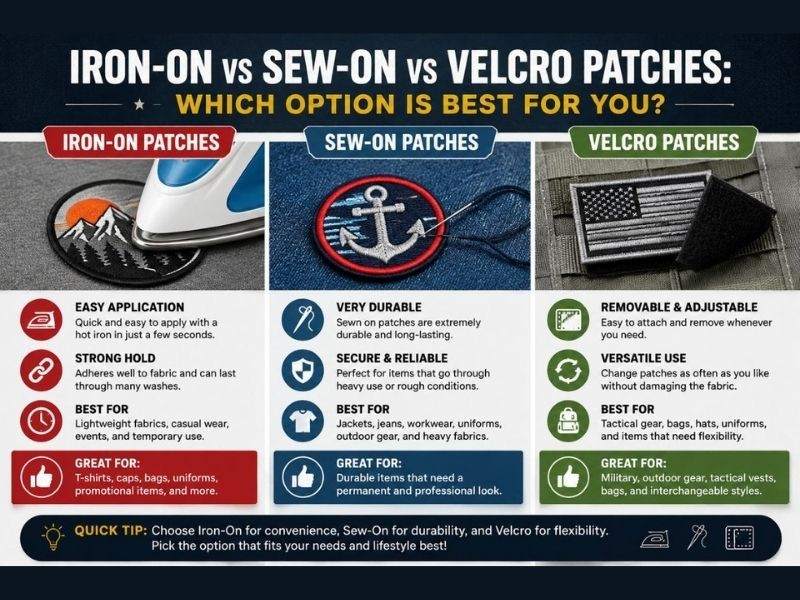
Iron-On vs Sew-On vs Velcro Patches: Which Is Best?
Choosing a patch is not only about the design. The backing you choose affects how easy the patch is to attach and how well it stays in place over time. Iron-on, sew-on and Velcro patches each work differently and suit different types of custom patches, uniforms and gear.
So which one should you choose? It depends on how often you will use the item, how much wear it will face and whether you want the patch to stay permanently or be removed when needed. This guide breaks down the three options to help you choose the right one.
Let’s Compare The Three Major Types Of Patches
Iron-On: Best for Cotton and Denim
A heat-activated adhesive sits on the back of the patch. Press it with an iron or heat press. The glue melts into the fabric, and it bonds as it cools. No sewing, no extra tools beyond something to apply heat.
Iron-On Fabric Fit
Cotton, denim, and polyester-blend garments take the bond well. The adhesive grips into the weave and stays put through normal wear.
Iron-On Fabric Limits
Nylon, waterproof shells, and tightly coated fabrics are a different story. The glue can’t get a proper grip, and the heat needed to try can damage the material itself.
Iron-On Wash Life
Expect the bond to hold for around 25 wash cycles on compatible fabric, less with hot water or regular tumble drying. For quick, low-effort application on the right material, Iron On Patches are usually the easiest starting point.
Sew-On: Best for Leather and Nylon
There’s no adhesive involved. The patch gets stitched directly onto the fabric with a needle and thread, either by machine or by hand. The thread does all the work, so heat never enters the equation.
Sew-On Fabric Fit
Leather, nylon, and other heat-sensitive materials work fine here since nothing needs to melt or bond under a hot iron. It also holds well on cotton and denim if you want the most secure option available.
Sew-On Durability
A properly stitched patch generally lasts as long as the garment itself. It won’t lift at the edges or weaken with repeated washing the way adhesive can.
Sew-On Tradeoff
It takes more time and either a sewing machine or steady hands. For anything meant to stay on permanently, that extra effort is what makes Sew On Patches the more dependable choice.
Velcro Works Best for Frequent Changes
This one works differently. The patch carries the hook side of the fastener, and a loop panel gets sewn onto the garment once. After that, the patch presses on, holds through regular wear, and pulls off cleanly whenever you need to change it.
A few things worth knowing before you go this route:
- Works well for uniforms, team gear, and roles that change often, since one garment can carry different patches over time.
- Swapping takes seconds. No tools or stitching are needed once the loop panel is in place.
- Adds a bit of thickness and stiffness compared to the other two backings.
- Can pick up lint or debris over time, so an occasional clean keeps the grip solid.
For anything that needs to change regularly without replacing the whole garment, Velcro patches are usually the practical pick.
What Each Backing Costs
Backing type does affect price, but not as much as quantity does. Per-unit cost drops sharply as order size goes up, no matter which backing you pick. Iron-on and sew-on are usually priced the same at the manufacturing stage, since the real cost difference shows up later, in how much labor or equipment the application takes. Velcro is the one that typically carries an added flat charge, since it involves a second component, the loop panel, beyond the patch itself.
| Backing Type | Cost Trend (small to bulk orders) | Flat Surcharge |
| Iron-On | Drops significantly at higher quantities | None |
| Sew-On | Drops significantly at higher quantities | None |
| Velcro | Drops significantly at higher quantities | Usually a small flat fee per order |
On a small order, that Velcro surcharge is noticeable. On a bulk order, it barely moves the total. Worth factoring in only if your project genuinely needs the swap-out flexibility.
What You’ll Need to Apply Each One
Application effort depends less on the patch and more on what you already have at home or in-house. Some backings need almost nothing. Others need a specific tool or a bit of practice.
Iron-On Setup
A household iron or heat press is all it takes. No sewing skills, no extra equipment. Anyone can learn the basic technique in a few minutes, which is part of why Iron On Patches remain the go-to for quick, low-effort application.
Sew-On Setup
A sewing machine speeds things up, but hand stitching works too if you’re patient and reasonably steady with a needle. It takes longer than ironing, and getting a clean line without puckering the fabric takes a bit of practice.
Velcro Setup
The loop panel needs to be sewn on once, so it requires the same setup as sew-on. After that, no tools are needed. Attaching and swapping the patch itself takes seconds.
Iron-On, Sew-On, or Velcro: Pick by Use
The right backing depends on how the item gets used, not which one seems easiest at the moment. A few common situations make the choice pretty clear.
Casual, One-Time Use
A jacket, cap, or bag you’re customizing for yourself, worn normally and washed occasionally. Iron-on covers this without any extra effort.
Permanent, Heavy-Wash Items
Uniforms, workwear, or anything that goes through frequent washing and needs to stay put for years. This is where Sew On Patches makes the most sense, since stitching won’t loosen the way adhesive eventually does.
Frequently Rotated Patches
Gear where the patch itself needs to change often, team kits, roles, or rank. Velcro handles this better than the other two, since nothing needs to be re-applied each time.
Match the backing to the scenario first, and the rest of the decision gets a lot easier.
FAQs
How long do iron-on patches last?
Roughly 20 to 30 wash cycles, or about six months to two years of regular wear, depending on the fabric and how it’s washed.
Can you sew on an iron-on patch?
Yes. Many people iron it first to hold it in place, then stitch around the edges for a permanent hold.
Which is better, sew-on or iron-on patches?
It depends on the fabric and how often the item gets washed. Sew-on lasts longer and works on any material; iron-on is faster but limited to heat-safe fabrics.
Can Velcro patches be ironed on?
No. Standard Velcro melts under heat, so it needs to be sewn on or attached with fabric glue instead.
What fabric works best for patches?
Cotton, denim, canvas, and twill hold up well across all three backing types. Nylon, leather, and waterproof materials are safest with sew-on only.
Conclusion
The backing decision matters more than it usually gets credit for. Fabric type, wash frequency, and how long you need the patch to stay put all point toward one option over the others. Iron-on works well for casual, low-effort use. Sewing holds up for anything permanent or heavy-wear. Velcro makes sense when the patch itself needs to change. Decide based on how the item will actually be used and cared for, not on whichever option seems quickest at checkout.

Hi, I’m Emma Carter. I write about custom iron on patches, creative designs, and branding ideas. I enjoy sharing practical tips and simple guides to help businesses teams and individuals choose the right patches for their projects.